SonicPure Pulsar 4400 vs. Narrow/Adaptive Tuning
SonicPure Pulsar 4400 vs. Narrow/Adaptive Tuning
Broad-spectrum algae control without the retuning cycle.
Most systems react to the algae bloom you can already see. SonicPure Pulsar 4400 uses a constant sweep of 4,400 discrete frequencies to provide broader, more proactive protection across changing water conditions.
The Core Problem: The Succession Trap
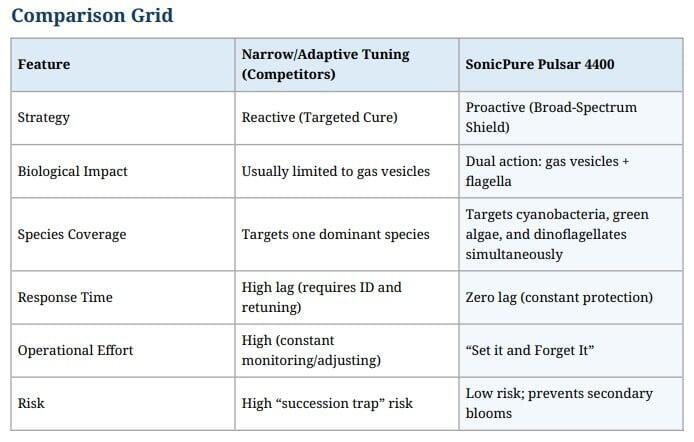
Many competitive systems use a reactive, narrowly tuned approach. They identify the current dominant algae species and tune their hardware to a specific frequency intended to affect that single target or often this retuning has to be done remotely by the manufacturer increasing response time. In real-world water systems, that can create a biological “succession trap” instead of lasting control.
- The Power Vacuum: When a narrowly tuned system suppresses only the dominant species, it can clear the field for another previously suppressed species to bloom aggressively.
- The Identification Lag: By the time a new bloom is identified and a customer requests a retune, the new species may already be established.
- Aesthetic Failure: A system tuned for cyanobacteria may still allow green algae to thrive, leading to poor clarity and customer dissatisfaction.
The SonicPure Solution: The 4,400-Frequency Shield
- SonicPure Pulsar 4400 takes a proactive approach. Instead of guessing which frequency is needed today, it uses a constant broad-spectrum sweep of 4,400 discrete frequencies to target multiple biological mechanisms throughout the water column.
- Buoyancy Disruption: Targets gas vesicles in cyanobacteria (blue-green algae), reducing their ability to remain suspended near the surface.
- Motility Paralysis: Targets flagella in green algae and toxic dinoflagellates such as Chattonella and Heterosigma. Cells that cannot move effectively toward light and nutrients eventually die of starvation.
- No tuning window: the system remains effective as species composition shifts over time.
- Proactive suppression: the broad sweep targets both current blooms and the “bench players” waiting to replace them.
- Lower operating complexity: no ongoing manual or AI tuning cycle is required.
- No hidden tuning costs: customers are not trapped in repeated recalibration or external testing services.
1. Two Pronged Biological Attack
2. Set-It-and-Forget-It Simplicity